|
|
|
◆ Renaissance Edition ◆
AfRID Monthly
|
April 2026
|
|
|
Featured This Month
AfRID
Renaissance
Workshop II
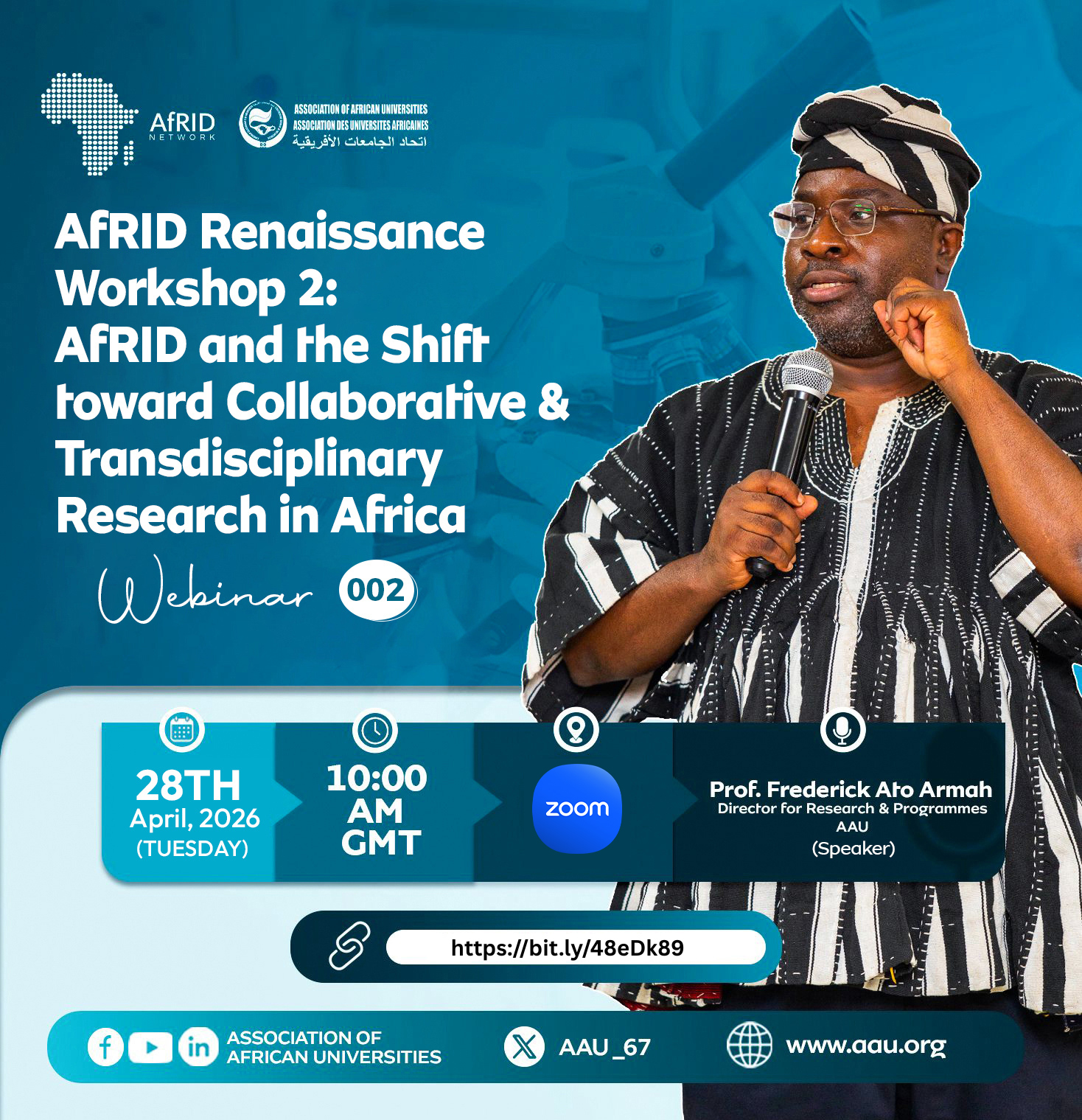
“AfRID and the Shift toward Collaborative & Transdisciplinary Research in Africa.”
|
28
APRIL 2026 · 10:00 GMT
|
|
|
|
Keynote Speaker
Prof. Frederick Ato Armah
Director, Research
& Programmes — AAU
|
|
|
|
☉
Date
Tue, 28 Apr
|
◷
Time
10:00 AM GMT
|
⚑
Platform
Zoom
|
⚛
Series
AfRID #002
|
|
|
bit.ly/48eDk89
|
|
❖ The Cover Story
Reimagining African Science: A New Renaissance
in Research
|
T
|
he
workshop will explore the emerging role of the African Research, Innovation and Development
(AfRID) Network in shaping the future of science across Africa. It will focus on the ongoing shift
from fragmented, discipline-based research toward more collaborative, transdisciplinary, and
impact-driven approaches to knowledge production.
|
Participants will examine how integrating diverse academic fields, alongside the active involvement of
policymakers, industry stakeholders, and communities, can enable the co-creation of knowledge that is
better aligned with Africa’s development priorities. The workshop will emphasize the importance of
moving beyond interdisciplinary work toward truly transdisciplinary models that connect science with
society.
|
| |
“
A truly transdisciplinary model of research connects science with society — the future of
African scholarship is co-created.
— AfRID Vision 2030
|
|
|
❖ Three Pillars of the Renaissance
What this gathering unlocks for the continent
|
01
Co-creation of Knowledge
Bridging academia,
policymakers, industry and communities into a single ecosystem aligned with Africa’s
priorities.
|
|
02
Digital Infrastructure
Shared data platforms
strengthening cross-border collaboration and the global visibility of African scholarship.
|
|
03
Problem-Oriented Science
Targeted research in public
health, climate change, food security and sustainable development across the continent.
|
|
|
|
|
❖ Continued
Open Science, Inclusivity & the Next Generation of Scholars
A key area
of discussion will be the growing role of digital platforms and shared data infrastructures in
strengthening research ecosystems. AfRID will be presented as a tool for enhancing cross-border
collaboration, improving access to research outputs, and increasing the global visibility of African
scholarship.
The
workshop will also consider the need to prioritize problem-oriented research, particularly in areas such
as public health, climate change, food security, and sustainable development. In this context, AfRID is
expected to support more strategic, evidence-based decision-making and better alignment between research
and policy.
In
addition, participants will reflect on the importance of open science,
inclusivity, and capacity building as foundational elements for the future. Discussions will
highlight ways to expand participation, support emerging researchers, and ensure equitable access to
knowledge and resources.
Overall, the workshop is expected to position AfRID as a catalyst for a more connected, inclusive, and
solution-focused scientific ecosystem in Africa — with the potential to redefine how research is
conducted and applied across the continent.
|
|
❖ AfRID at a Glance ❖
|
|
2,000+
Institutions
|
54
African Countries
|
200K+
Scholars
|
6.7M+
Publications
|
|
|
|
❖ Programme
A journey through the morning
|
10:00 – 10:05
|
|
Welcome & Scene Setting (5 mins)
Opening remarks and
introduction to the workshop series. Brief overview of the AfRID Network and the purpose of
today’s session.
|
|
10:05 – 10:20
|
|
Hands-On Activity: Mapping the Evolution of Research (FigJam) (15 mins)
Participants will
collaborate on a live FigJam board to map and visualise the evolution from disciplinary to
interdisciplinary to transdisciplinary research. Working in small groups, participants will
identify key transitions, barriers, and enablers at each stage, and reflect on where African
research currently sits on this spectrum.
|
|
10:20 – 10:35
|
|
From Fragmented to Transdisciplinary: Rethinking Research in Africa (15 mins)
Exploring the shift
from siloed, discipline-based research toward collaborative and transdisciplinary models.
Discussion of how integrating diverse academic fields with policymakers, industry, and communities
enables co-creation of knowledge aligned with Africa’s development priorities.
|
|
10:35 – 10:50
|
|
AfRID as a Digital Infrastructure for Collaboration (15 mins)
AfRID as a platform
for cross-border collaboration, open access to research outputs, and increased global visibility
of African scholarship. Focus on how shared data infrastructures are strengthening research
ecosystems across the continent.
|
|
10:50 – 11:00
|
|
Open Discussion & Closing Reflections (10
mins)
Participant
Q&A, key takeaways, and a forward look at AfRID’s role as a catalyst for a more
connected, inclusive, and solution-focused scientific ecosystem in Africa.
|
|
|
Be Part of the Renaissance
Join us. Shape the future of African research.
|
|
© 2026 Association of African Universities. All rights reserved.
You received this newsletter as a member of the AAU community.
Unsubscribe ·
Update Preferences
|
|
|
|
|

